Phenomenon-Based Learning: A Teacher's Guide
Some of the best questions kids ask don't fit inside one subject.
A student asks why the river near school floods some years and not others. To really answer that, you'd need a bit of science, a bit of geography, some math, maybe a conversation with the town. But your timetable says it's third-period English, so the question gets a quick reply and the moment passes.
That's the gap phenomenon-based learning is built to close. Instead of slicing the world into subjects and hoping kids reassemble it later, you start with a real thing worth understanding and let the subjects show up where they're needed.
In this guide:
- What phenomenon-based learning actually is
- Why it works, and where the evidence comes from
- A step-by-step way to run a module
- A real grade 5 science-and-geography example
- Variations, common mistakes, and quick answers to FAQs
What is phenomenon-based learning?
Phenomenon-based learning (PhBL) is an approach where students investigate a real-world topic from several subjects at once, rather than studying each subject in isolation. The "phenomenon" is something genuine and complex, like water, migration, or climate, that naturally pulls in science, math, language, history, and the arts.
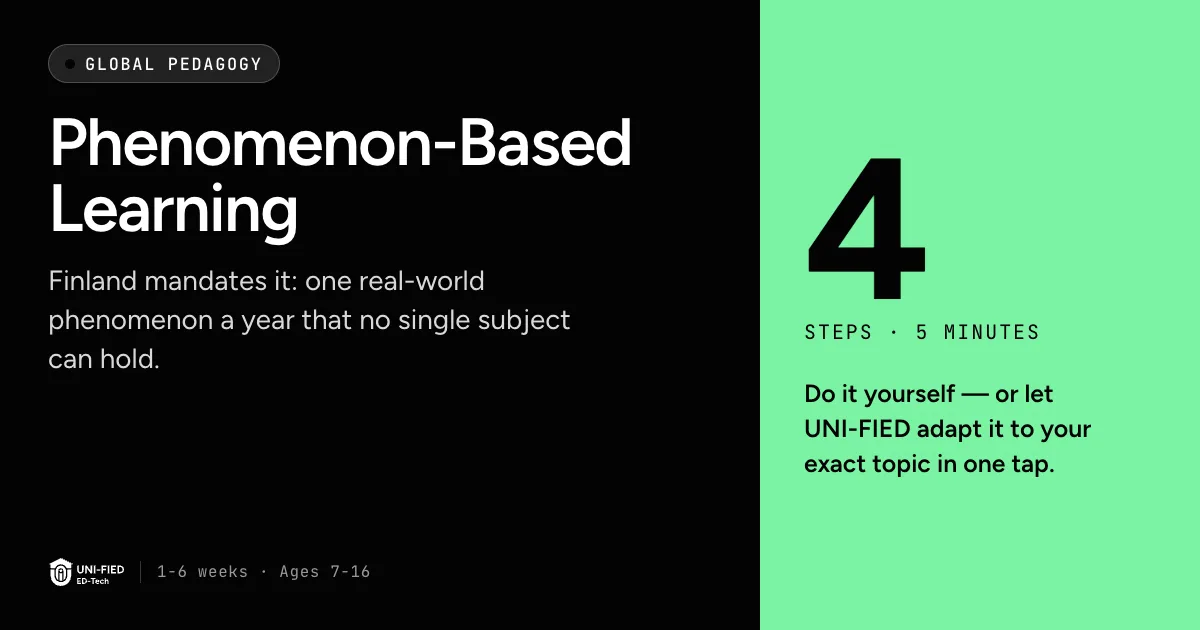
It became well known through Finland's 2016 National Core Curriculum, which requires every student aged 7 to 16 to take part in at least one multidisciplinary module each year. A module usually runs one to six weeks, and teachers from different subjects plan it together.
The key shift is the starting point. You don't begin with "today's lesson on the water cycle." You begin with "water," and the water cycle becomes one of the things students need in order to make sense of it.
Why does phenomenon-based learning work?
It works because real questions don't respect subject lines, and learning that crosses those lines transfers better. The Finnish National Agency for Education (OPH) built PhBL into the core curriculum specifically to develop what they call transversal competences, like thinking and learning-to-learn, multiliteracy, and building a sustainable future, that no single subject can teach on its own.
There's a simple cognitive reason behind this. When students meet a fact inside a meaningful, messy context, they have more places to hook it onto, so they remember it and can use it again somewhere new. A graph of rainfall data means more when it's helping answer a question the class actually cares about.
Timothy D. Walker, an American teacher who taught in Helsinki and wrote Teach Like Finland, points to a few habits that make these modules land: planning with students, making the work real, and shifting the teacher's role from lecturer to coach. The phenomenon supplies the "why," and that's usually the part students are missing.
It's worth being honest, too: PhBL isn't meant to replace all subject teaching. In Finland it sits alongside regular lessons as a deliberate, recurring module, not the whole school year.
How to run phenomenon-based learning, step by step
You can run a small version of this with one class and a couple of subjects. You don't need a school-wide overhaul. Here's a workable sequence.
- Pick a phenomenon worth the time. Choose something authentic, complex, and relevant to your students: water, food waste, the local river, a fair election, energy in the home. If it can be answered with a single Google search, it's too small.
- Map the subjects it touches. Before you involve students, jot down where science, math, language, geography, history, and the arts could each contribute. This tells you whether the topic is rich enough and which colleagues to invite.
- Plan with your students. Bring the phenomenon to the class and let them shape the driving questions, the methods, and what they'll produce. Co-planning is central to PhBL, not a nice extra; it's where ownership comes from.
- Investigate from multiple angles. Students work in groups to explore different facets, collecting data, reading, interviewing, measuring. Your job is to coach inquiry, not to be the subject authority with all the answers.
- Integrate the knowledge. Build in checkpoints where groups connect what they're finding across subjects, so the module becomes one coherent investigation rather than parallel mini-lessons.
- Make something and share it. End with a product, exhibition, or performance for a real audience: a presentation to younger classes, a display for parents, a proposal for the town. A real audience raises the quality of everything.
- Reflect and assess. Look back not just at the content but at the competences: How did they work together? How did they handle conflicting information? Use multiple methods, including student self-assessment.
A real example: grade 5 science and geography
Take "Our local river" with a grade 5 class, blending science, geography, math, and writing over three weeks.
You open by walking the class down to the river (or showing photos and a map if you can't) and asking what they notice and wonder. Their questions become the module's backbone: Why does it flood? Is the water clean? What lives in it? Who decides what gets built nearby?
In week one, groups split the questions. One team tests water clarity and temperature (science), another maps the river's path and the land around it (geography), another pulls flood data from past years and graphs it (math). Week two, they read and interview, maybe a call with someone from the local water authority. Week three, each group writes up findings and the class builds a shared display.
The math isn't a worksheet anymore; it's the rainfall graph that explains the flooding their classmate asked about. That's the whole point. By the end, students can explain the river the way an expert might, because they had to pull from several subjects to do it.
Variations and when to use it
You can scale this up or down depending on your situation.
- Single-teacher version: Run it inside your own subject but pull in neighboring ones lightly. A science teacher can still bring in graphing and a written report without a co-planner.
- Team-taught module: The fuller Finnish model, where two or more teachers co-plan and team-teach across disciplines. Best when you have shared planning time.
- Multidisciplinary Learning Module (MLM): A whole-grade theme, like "Our school as an ecosystem," where biology does a biodiversity count, math handles the data, geography maps it, and language arts writes it up.
- Project programs like StarT: LUMA Centre Finland runs an interdisciplinary program where students combine STEM with arts and share projects internationally, if you want an external audience.
Use PhBL when a topic is genuinely cross-cutting and you have a stretch of time to do it justice. It's a poor fit for content that's better taught in a tight, sequential way, like introducing a brand-new procedural math skill. Save phenomena for the big, connected ideas.
Common mistakes to avoid
The most common one is picking a phenomenon that's too narrow. "The water cycle" is a topic; "water in our community" is a phenomenon. If the subjects don't all have something real to add, it collapses back into a single lesson with decoration.
A second trap is skipping the student co-planning. If you hand students a fully scripted project, you've built a normal unit and lost the agency that makes PhBL work. Let them shape the questions even if it feels messier.
Third, watch for "parallel play," where each subject does its own thing and they never actually connect. Build explicit moments where groups have to integrate findings, or the module won't add up to more than its parts.
Finally, don't let assessment default to a single test. The learning here is partly in the collaboration and the thinking, so use products, presentations, and self-assessment alongside any content check.
How UNI-FIED helps
Planning a cross-subject module from scratch is the part that stops most teachers, especially without shared planning time. UNI-FIED builds routines like phenomenon-based learning into ready-to-teach activity cards for your specific topic and grade, with the driving questions, the subject connections, and the steps already mapped out, so you can adapt rather than start from a blank page.
Frequently asked questions
How long should a phenomenon-based module last? Most run one to six weeks. Start short, even one week across two subjects, and lengthen as you and your students get comfortable with the format.
Do I need other teachers to do this? No. The full Finnish model uses team-teaching, but you can run a smaller version solo by lightly pulling in neighboring subjects inside your own class.
Isn't this just project-based learning? They overlap, but PhBL always starts from a real-world phenomenon and is explicitly multidisciplinary. A project can live inside one subject; a phenomenon, by design, can't.
How do I grade it? Use a mix: a content check if you need one, plus the final product, presentation, and student self-assessment. In Finland, the transversal competences, like collaboration and handling information, are part of what gets assessed.
What grades does it work for? Finland mandates it for ages 7 to 16, and it's used in upper-secondary too. The phenomenon and the depth change with age, but the approach scales across the grades.
Pick one question your students keep asking that doesn't fit a single subject, and you've already found your first phenomenon.
Sources & further reading
Run this in your classroom tomorrow
UNI-FIED turns your topic, grade, and lesson length into ready-to-teach activity cards built on routines like this one — no prep, no curriculum change.
See how UNI-FIED worksRelated routines
Published November 17, 2026.