Blood Delivery Service: Rank the Rush Orders
The circulatory system runs like a delivery service — so hand students four rush orders and ask which one the body fills first.
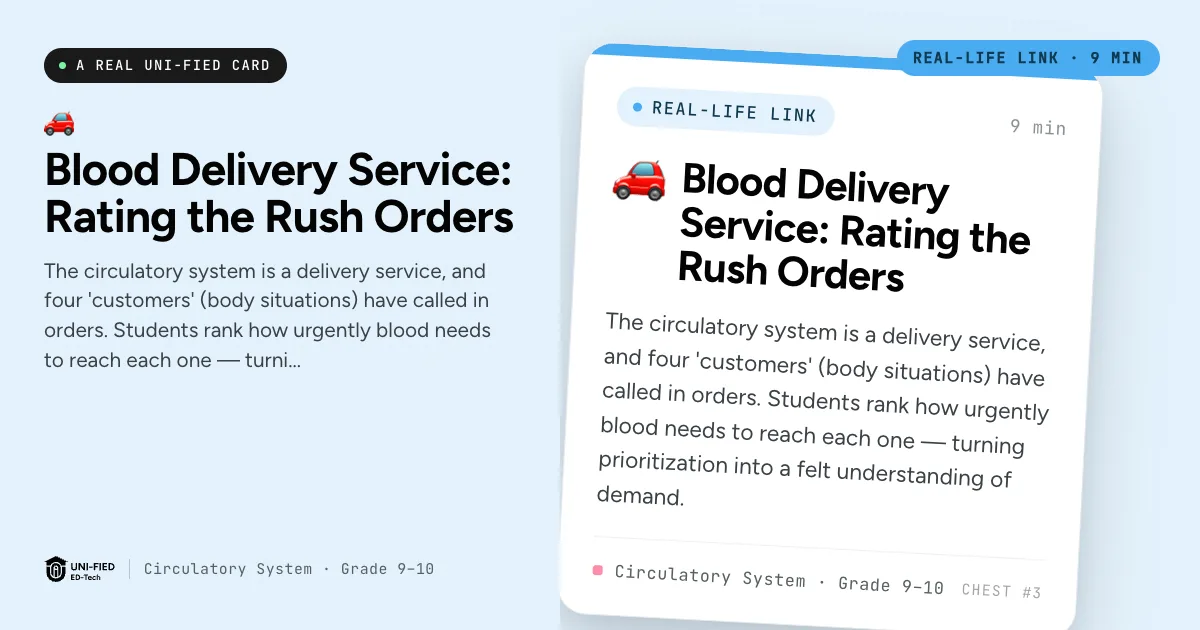
Tell your class the heart isn't a pump today — it's a delivery company. Four customers just called in orders, and the dispatch board is full. Now ask them: which order goes out first, and which one waits?
That single question turns a labeling diagram into a real decision students have to defend. Here's the whole activity, ready for tomorrow.
What students do
This is a Grade 9-10 circulatory system activity called "Blood Delivery Service: Rating the Rush Orders." The setup is simple: the circulatory system is a delivery service, and four "customers" have called in orders. Each customer is a different body situation — a muscle mid-sprint, a stomach digesting a big lunch, the brain during a test, skin on a freezing day, that kind of thing.
Students don't just describe the situations. They rank them by how urgently blood needs to reach each one, then explain their order.
That ranking step is the whole point. It takes prioritization — an abstract idea — and makes students feel it. They can't put all four customers at the top, so they have to decide what the body actually does when demand spikes in more than one place at once. The argument that breaks out over the order is where the learning happens.
It runs in about nine minutes, which makes it a strong opener or a mid-lesson reset rather than a whole-period project.
How to run it
You need almost nothing: the four customer situations (write them on the board or hand out slips), and somewhere for each group to record their ranking.
Set the scene (1 min). Tell the class the circulatory system is a delivery service. The heart is dispatch, the vessels are the roads, blood is the cargo. Four customers just called in orders.
Reveal the four orders (1 min). Give students the four body situations. Suggested set: legs during a sprint, the stomach an hour after a big meal, the brain during a hard exam, and the skin when someone steps out into the cold. You can swap any of these.
Rank in pairs or threes (3 min). Each group puts the four orders in priority order — who gets blood first, second, third, last. The rule: every group must rank all four. No ties. That forced choice is what makes them argue and reason.
Justify (2 min). Each group writes one sentence per ranking: why this customer beats that one. Push them to use cause and effect, not just "it feels important." A sprinting muscle needs oxygen and glucose fast and is dumping waste it needs cleared.
Compare and reveal (2 min). Take two or three different rankings from the room. Where do groups disagree? Now bring in the real biology: the body actually does redirect blood flow on the fly, narrowing vessels to low-demand areas and widening them to high-demand ones. There often isn't one perfect answer — and that's the honest truth about how the body juggles competing demands.
If you have an extra minute, throw in a curveball: "Now the person is sprinting AND it's freezing. Re-rank." Watch them realize the body is solving this exact conflict constantly.
The learning science behind it
Two things are doing the heavy lifting here, and both are well established.
The first is the concrete analogy. Mapping an invisible system onto something students already understand — a delivery service with dispatch, roads, and rush orders — gives them a familiar structure to hang new facts on. Analogies like this are one of the routines Project Zero groups under "Generating Possibilities and Analogies," and the reason they work is that students reason from the thing they know (how orders get prioritized) into the thing they don't (how blood flow redistributes). The analogy isn't decoration; it's the scaffold.
The second is the forced ranking. When you make students order four items with no ties allowed, you remove the escape hatch of "they're all important." That constraint forces comparison, and comparison forces them to surface their reasoning. It's the same engine behind ranking and prioritization protocols used in discussion-based teaching: the disagreement between groups is the feature, not a problem to smooth over. Students defend, hear a competing view, and revise — which is far stickier than copying a labeled diagram.
Put together, the activity moves students from naming parts of the circulatory system to reasoning about what it does under pressure. That's the jump from memorizing to understanding, and it happens because they had to make a choice and back it up.
How to adapt it
The "rate the rush orders" shape works for almost any system with limited resources and competing demands.
- Other science topics: Rank which plants get water first in a drought (ecosystems). Rank which part of a circuit fails first when overloaded (physics). Rank which nutrient a deficient body needs most urgently (nutrition).
- Younger grades: Keep the delivery analogy but use three customers instead of four, and accept a simple "first/middle/last" with a one-word reason.
- Outside science: In history, rank which factors most caused an event. In economics, rank where a town should spend a limited budget. The mechanism — force a no-ties ranking, then defend it — travels anywhere students need to weigh trade-offs.
The trick is always the same: pick a real constraint (limited blood, water, money, time), give a small set of competing claims on it, and make students commit to an order.
Get activities like this for your class
This card came straight out of the UNI-FIED activity library — it's one of the ready-to-teach activities the platform generated for a Grade 9-10 circulatory system lesson. You type in your topic and grade, and UNI-FIED deals you a hand of classroom-ready activity cards like this one, each grounded in a real teaching routine and fitted to your curriculum. The prep is a few minutes instead of a few hours.
Try it the next time you're staring at a topic and a blank lesson plan. Type "circulatory system, Grade 9," and see what comes back — then run the rush orders tomorrow and let your students argue.
Sources & further reading
- UNI-FIED activity library
Run this in your classroom tomorrow
UNI-FIED turns your topic, grade, and lesson length into ready-to-teach activity cards built on routines like this one — no prep, no curriculum change.
See how UNI-FIED worksRelated routines
Published November 4, 2026.