Body Detective: Diagnose the Failing Circuit
Hand each group a patient file for a sick nine-year-old, and don't tell them which organ is failing.
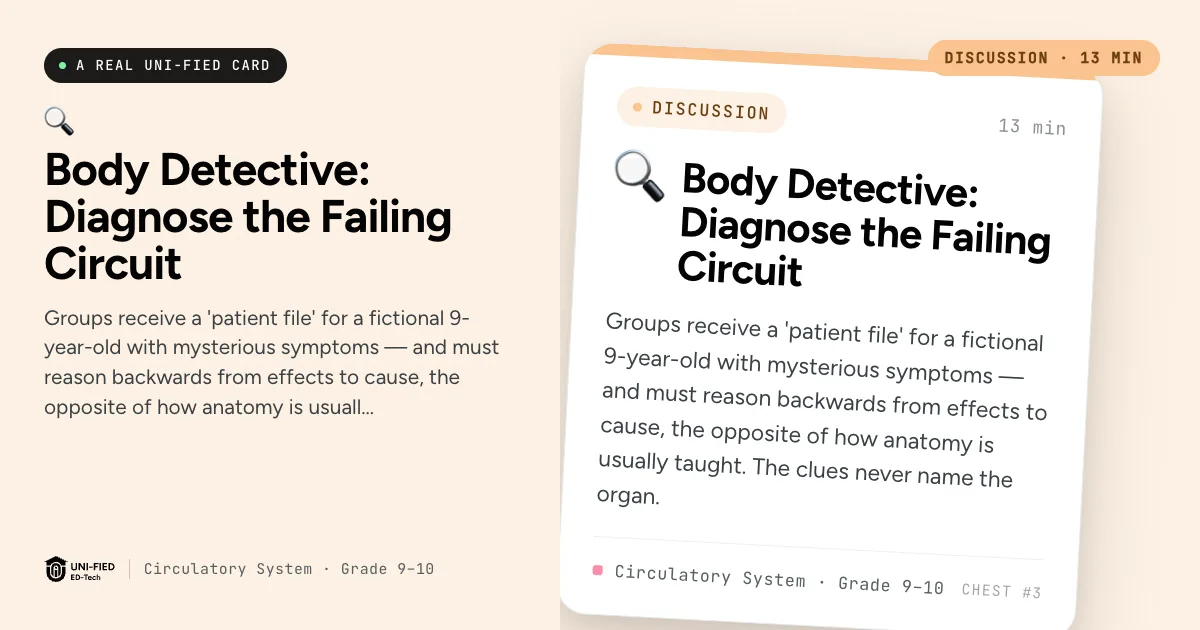
You hand each group a single sheet of paper: a patient file for a fictional nine-year-old with a strange set of symptoms. Tired all the time. Cold hands and feet. Out of breath after a short walk. Nowhere on the page does it say "heart" or "blood" or name the organ that's failing. Their job is to work backward from those clues and figure out what's broken.
That's the whole activity. It runs in about thirteen minutes, and it flips anatomy on its head. Instead of memorizing parts and then being told what they do, students start with the consequences and have to reason their way back to the cause.
What students do
This is a discussion card for a Grade 9-10 circulatory system lesson. Students work in small groups, each with the same patient file in front of them.
The file describes a fictional nine-year-old with mysterious symptoms. The catch is the one that makes the whole thing work: the clues never name the organ. The file talks about how the kid feels and what their body is doing, not about which structure is misbehaving.
So groups have to reason backward, from effects to cause. That's the opposite of how anatomy usually gets taught. Normally you learn the heart pumps, the arteries carry oxygen-rich blood, the veins bring it back, and then you get asked what happens if one of those fails. Here, students start at "what happens if it fails" and have to rebuild the system from the symptoms up.
To get there, they have to actually use what they know about circulation. Why would a circulation problem make your hands cold? What does shortness of breath tell you about oxygen delivery? Tiredness everywhere, all the time, points to a whole-body supply issue, not a local one. Each symptom is a piece of evidence, and the group's diagnosis is their argument about what fits all of it.
How to run it
This is a no-materials activity beyond the patient file itself. Here's the version you can run tomorrow.
Materials
- One printed patient file per group (the symptom list for your fictional nine-year-old)
- Scratch paper or a whiteboard per group for their working
- Optional: a single diagram of the circulatory system the class can refer to
Steps
- Put students in groups of three to five. Hand each group the patient file face down and tell them not to flip it yet. (1 minute.)
- Set the frame: "You're the medical team. This patient has symptoms but no diagnosis. Your job is to figure out what part of the circulatory system is failing, using only what's on this page." (1 minute.)
- Groups flip the file and read it together. Each person marks the symptoms that jump out at them. (2 minutes.)
- Round one, Challenge: groups argue about what each symptom rules in and rules out. Cold hands? Tiredness? Push them to say why a symptom points where it does, not just that it does. (4 minutes.)
- Round two, Concepts: each group commits to a diagnosis and names the key circulatory concepts behind it, such as oxygen delivery, pumping pressure, or blood flow to the extremities. (3 minutes.)
- Quick share-out: one sentence per group on their diagnosis and the single strongest clue that got them there. Then you reveal or discuss the answer and where their reasoning held up. (2 minutes.)
Total time is about thirteen minutes. From here you can move into the structure that's actually failing, or use the disagreements between groups as the launch point for the next part of your unit.
The learning science behind it
This card is grounded in Project Zero's 4 Cs protocol, and it leans on two of the four: Challenge and Concepts.
The 4 Cs come from Harvard's Project Zero as a small-group routine where students process the same material through different thinking lenses. The full set is Connections, Challenge, Concepts, and Changes, and the point is that each "C" activates a different kind of thinking, so the same content gets worked over from several angles instead of one.
This activity zooms in on two of them on purpose. Challenge asks students to interrogate and argue, which is exactly what diagnosing demands: does this symptom really mean what we think it means, or could it point somewhere else? Concepts asks them to name what's worth holding onto, so by the end they aren't just saying "it's the heart," they're saying "it's a pumping or delivery problem, and here's the concept that explains it." That keeps the reasoning anchored to real circulatory ideas instead of guesswork.
There's a deeper reason the backward direction works. When you give students the answer first and the symptoms second, they recognize. When you give them the symptoms and make them find the answer, they reason. Retrieving and applying knowledge to solve a problem is a much stronger way to lock it in than reading it described. The patient file forces that retrieval, because the page won't do the thinking for them.
And the missing organ name matters more than it looks. The second you write "heart failure" on the file, the puzzle is over and the talking stops. Leaving it out is what creates the gap students have to argue across, and the arguing is where the learning lives.
How to adapt it
The bones of this work for any topic where a system can break and the breakage shows up as symptoms.
For a younger group, shorten the file to three or four clear symptoms and let them match to a simpler set of causes. The backward reasoning still happens, just with less to juggle.
For other topics, swap the patient and the system:
- Respiratory system: a patient with the same kind of mystery file, but the failing part lives in the lungs or airways.
- Ecosystems: a "sick" pond or forest with observable signs, and groups reason back to the missing or broken piece of the food web.
- Electrical circuits: a device that won't work right, with symptoms instead of a wiring diagram, and groups diagnose the failing component.
- History or economics: a society or economy showing "symptoms," and groups reason back to the underlying cause.
The pattern stays the same every time. Describe the effects, hide the cause, and make the group argue their way back to it.
Get activities like this for your class
This card came out of UNI-FIED's activity library. You type in your topic and grade, and the platform deals you a hand of ready-to-teach activity cards, each one grounded in real pedagogy and fitted to what you're actually teaching. No blank lesson plan to stare at, no inventing a hook from nothing. You get something you can run with about three minutes of prep, like this one. Try it at UNI-FIED.
Give your students the symptoms and make them find the cause. They'll understand the system better than any diagram could teach them.
Sources & further reading
- UNI-FIED activity library
Run this in your classroom tomorrow
UNI-FIED turns your topic, grade, and lesson length into ready-to-teach activity cards built on routines like this one — no prep, no curriculum change.
See how UNI-FIED worksRelated routines
Published November 18, 2026.