The Number That Changes Without Permission
Every student walks into your room carrying a number their body set without asking them.
Ask a class of ninth graders to put two fingers on their wrist and stay still. Most of them will find the beat in a few seconds, and a few will need you to walk over and move their fingers a centimeter. Then you tell them to count, and the room goes quiet in a way it rarely does — because each of them has just met a number their own body is producing right now, without their say-so.
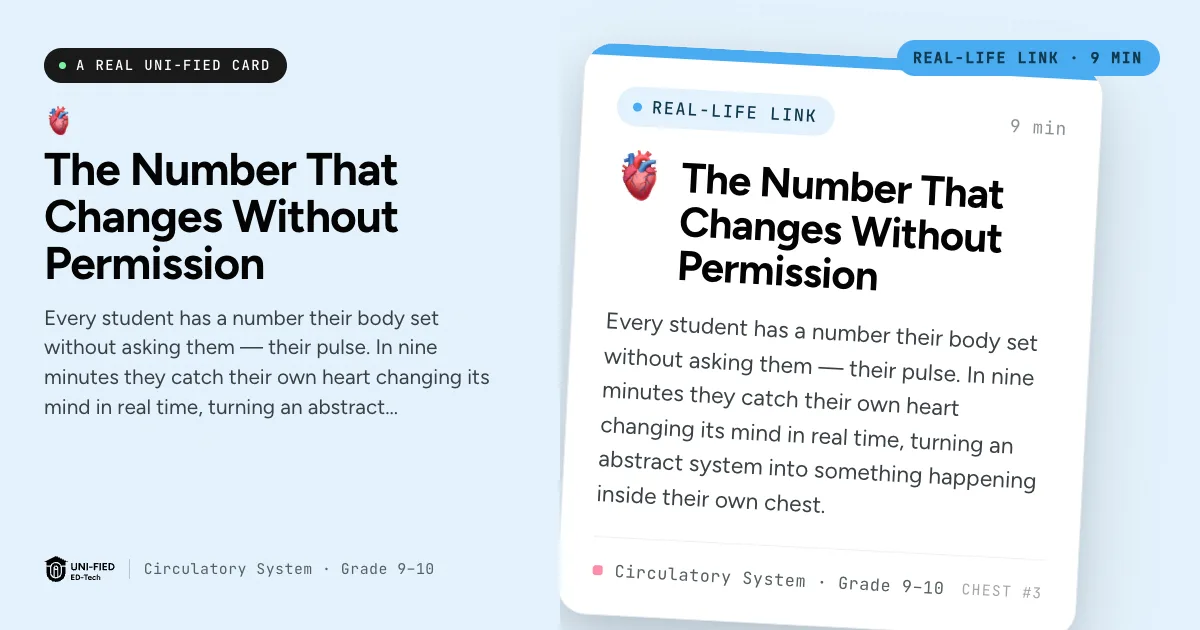
That's the whole premise of this activity. It's a real card UNI-FIED generated for a Grade 9-10 circulatory system lesson, called "The Number That Changes Without Permission." It runs in about nine minutes, and the only equipment is the students themselves.
What students do
Each student finds their own pulse and counts it. That number — their resting heart rate — becomes the thing they study for the rest of the activity.
The hook is simple and a little unsettling in a good way: this is a number your body decided on without asking you. You didn't choose 72. You can't just decide to make it 60. So who's in charge of it?
Then students make it change on purpose. They do something — stand up fast, do twenty jumping jacks, hold their breath, picture something stressful — and count again. The number moves. They watch their own heart change its mind in real time, and the abstract "circulatory system" on the board becomes a system that is, at that moment, doing something inside their chest.
By the end, every student has at least two data points that belong only to them, and a genuine question on the table: what is adjusting this number, and how does it know to?
How to run it
You can run this exactly as written tomorrow. Here's a clean version.
Materials: a clock or timer the whole class can see, and optionally a sticky note per student. That's it.
Timing: about 9 minutes.
- Find the beat (2 min). Have everyone press two fingers — not the thumb — to the inside of the wrist or the side of the neck. Give them quiet time. Walk around and help the students who can't find it; this is the step that fails if you rush it.
- Count the resting number (1 min). Count beats for 15 seconds, multiply by four. Each student writes their number down. Don't collect it, don't compare yet — it's theirs.
- Drop the hook (1 min). Say it plainly: nobody chose this number. Your body set it. Ask, out loud, "So who decided 72? And could you change it if you wanted to?" Let them sit with that.
- Change it on purpose (2 min). Pick one trigger the whole class does together — twenty jumping jacks works and gets them laughing. Right after, they find the beat again and count again.
- Second number (1 min). Write the new number next to the first. The gap is the point.
- Land the question (2 min). Ask what made it move, and how the heart "knew" to speed up before the muscles even needed it. Capture two or three of their guesses on the board. You are not answering yet — you're opening the lesson with their own data as the mystery.
If you have a few extra minutes, have students compare resting numbers in pairs and notice how different they are. That difference is its own good question.
The learning science behind it
This activity works because it's built on a real phenomenon the students experience directly, rather than a topic you announce. In NGSS storyline and phenomena-based teaching, this is the anchoring phenomenon routine: you present a real event without heavy framing, give students time to notice and wonder, and let their questions drive what comes next (see the anchoring routine in NGSS Storylines + Phenomena-Based Science).
The reason it lands is in one line from that work: a shared experience of a real phenomenon creates a collective puzzle the class owns. A diagram of the heart is information you're handing them. Their own pulse is a puzzle they're holding. Those are very different starting points for a lesson, and the second one is much harder to tune out.
There's a second thing going on, which is why the "without permission" framing matters. The activity makes the system personal before it makes it technical. The number isn't an example from a textbook — it's theirs, and it behaves in a way they didn't authorize. That small jolt of "wait, my own body is doing this without me" is curiosity you don't have to manufacture. UNI-FIED's card calls this a self-data concrete premise, and that's exactly what it is: the data the inquiry runs on comes from the student's own body.
The payoff is that you've now got real, student-generated data and real student questions before you've taught a single term. Everything that follows — heart rate, cardiac output, how the nervous system regulates the heart — answers a question they already asked. That's a stronger position than starting with vocabulary and hoping interest shows up.
How to adapt it
The shape here — give students a piece of self-data, then make it change and ask why — travels well beyond the heart.
- Younger grades (Grade 5-7): Keep it to resting versus after-exercise pulse and the single question "what changed it?" Skip cardiac output and regulation language entirely.
- Respiratory system: Count breaths per minute instead of heartbeats, then change it with exercise or by talking fast.
- Nervous system / stress: Use the same pulse, but the trigger is purely mental — picture a test, a deadline, a fright. The number still moves, which is a striking way into the fight-or-flight response.
- Other subjects: The "a number your body/life set without you" framing works for reaction time in PE, for screen-time data in a media literacy unit, or for any topic where students can generate a quick personal measurement and then poke at it.
The rule of thumb: pick something each student can measure about themselves in under a minute, make it visibly change, and protect the wondering step. The wondering is what makes it a lesson instead of a warm-up.
Get activities like this for your class
This is one card out of a hand UNI-FIED deals when you type in a topic and grade. You tell it "circulatory system, Grade 9-10," and it gives you ready-to-teach activity cards like this one — premise, steps, timing, and the pedagogy underneath — in about three minutes of prep. Each card is grounded in real teaching routines and fitted to your curriculum, not invented from nothing. You can try it at UNI-FIED.
Tomorrow, before you write a single word on the board, have them find their pulse. Let the number do the teaching.
Sources & further reading
- UNI-FIED activity library
Run this in your classroom tomorrow
UNI-FIED turns your topic, grade, and lesson length into ready-to-teach activity cards built on routines like this one — no prep, no curriculum change.
See how UNI-FIED worksRelated routines
Published October 28, 2026.