The City That Never Sleeps: A Circulatory System Hook
Before you draw a single arrow on the board, you tell them about a city that never sleeps.
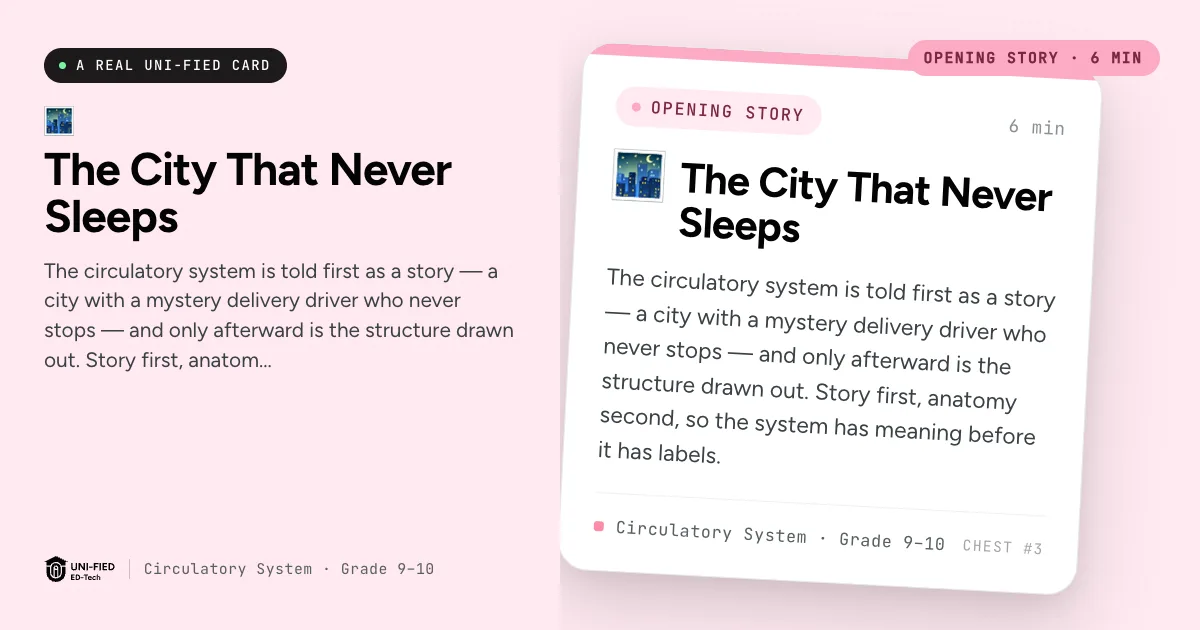
The bell rings, and instead of putting "The Circulatory System" on the board, you start talking about a city. A city that never goes dark, where one delivery driver keeps moving around the clock, hitting every neighborhood, never stopping for a break. Nobody has said the word "heart" yet, and that is the point.
This is a real opening-story card UNI-FIED generated for a Grade 9-10 circulatory system lesson, called "The City That Never Sleeps." It takes about six minutes. Here is how it works and why it lands.
What students do
For the first few minutes, students don't take notes and don't define anything. They listen to a short story.
The circulatory system is presented first as a story, not a diagram. There's a city that runs day and night, and a mysterious delivery driver who never stops moving, dropping off what every part of the city needs and picking up what it wants gone. The whole network only works because that driver keeps the loop going.
Only after the story has landed do you draw out the structure. The driver is blood. The city is the body. The routes are vessels. The thing keeping it all moving, the part that never sleeps, is the heart. The labels come second, once the system already means something.
That order is the whole activity. Story first, anatomy second, so the system has a shape in their heads before it has a single technical name.
How to run it
You don't need slides for this. You need a story and a board.
Materials: Just you telling the story. Optionally, a simple city map or grid sketch you can draw on, or one image of a city skyline at night to set the scene. A whiteboard for the reveal.
Timing: About 6 minutes total. Roughly 3 to 4 minutes of story, 2 to 3 minutes to map it onto the real anatomy.
Set the scene (1 min). Tell them you're going to describe a place before you tell them what it is. Ask them to picture it. "There's a city that never sleeps."
Tell the story (2-3 min). Walk through the city and its one tireless delivery driver. The driver carries supplies to every neighborhood and hauls away the waste. Keep it concrete: what happens to a neighborhood if the driver skips it? What happens if the driver stops completely? Let the stakes sit for a second.
Pause and ask (1 min). Before you reveal anything, ask: "What do you think this city actually is? Who's the driver?" Take a few guesses. Some students will get it. Let them.
Draw out the structure (2 min). Now map it on the board. City equals body. Delivery driver equals blood. The routes equals blood vessels. The thing that never sleeps, the pump that keeps the driver moving, equals the heart. Write each label next to the story element it came from.
Hand off to the lesson. You now have your anchor. For the rest of the unit, you can point back to it: "Remember the driver. What happens on the route when a vessel narrows?" The story keeps doing work long after these six minutes.
The learning science behind it
This card is grounded in Culturally Responsive Teaching (Hammond, 2015), specifically the practice of using storytelling as cognitive scaffolding. The instruction Hammond gives is almost word for word what this activity does: tell the story first, draw out the structure second, then return to the story as a reference point throughout the unit.
Here's why the order matters. Narratives activate broad neural networks and stick in memory far longer than isolated facts do. When you open with "the heart pumps blood through arteries and veins," you're asking students to hold a stack of new labels with nothing to hang them on. When you open with a city and a driver who never stops, you give them a structure they already understand, and the anatomy slots into a place that's already built.
There's also a cultural piece worth naming. Many of your students come from homes and traditions where teaching happens primarily through story. Leading with narrative isn't a gimmick; it's congruent with how a lot of kids have learned things their whole lives, which lowers the barrier to engaging.
It rhymes with what science-education folks call a phenomenon-first or anchoring launch, where you hook the class on something puzzling before you hand them vocabulary. The shared image becomes a thing the whole room owns and keeps returning to. That return trip is the quiet power here: the story isn't just a warm opener you abandon, it's a reference point you can point back to every time the system gets more complicated.
How to adapt it
The "tell the story, then map the structure" move works for almost any system or process, not just this one.
- Younger grades. Keep the same city, simplify the reveal. For middle school, you might stop at heart, blood, and vessels and skip arteries versus veins for now.
- Other topics with a flow or a cycle. The water cycle becomes a journey one drop takes and keeps repeating. An ecosystem becomes a town where everyone trades with everyone. Supply and demand becomes a market with a rumor spreading. The respiratory system becomes a building's air system. Anything with parts that move things around is a candidate.
- Make it theirs. Hammond's stronger version invites students to retell, adapt, or extend the story. Have a pair re-tell "the city" in their own words, or add a new neighborhood and explain what the driver does there. That retelling is where the consolidation happens.
- Use it as a check later. Mid-unit, ask students to redraw the city map and label a breakdown: "A road closes. Walk me through what the driver does." You'll see fast who has the model and who has only the words.
Get activities like this for your class
This is one card out of a whole hand. UNI-FIED generates ready-to-teach activity cards like this one for any topic and grade you type in, each grounded in real pedagogy and mapped to your curriculum, in about three minutes of prep. You get the premise, the steps, the timing, and the reason it works, not just a worksheet. Try it at UNI-FIED.
Open with the city tomorrow. Let them meet the driver before they meet the heart, and watch how much more the anatomy sticks.
Sources & further reading
- UNI-FIED activity library
Run this in your classroom tomorrow
UNI-FIED turns your topic, grade, and lesson length into ready-to-teach activity cards built on routines like this one — no prep, no curriculum change.
See how UNI-FIED worksRelated routines
Published October 21, 2026.